
Aluminum Winding Strip VS Copper Winding Strip: Cost, Conductivity, and Weight
10.14.2026In transformer winding design, the choice of conductor material directly affects product cost, efficiency, temperature rise, size, and manufacturing process. Copper strip and aluminum strip are two commonly used materials for low-voltage winding, foil windings, and certain dry-type transformers.
Many people simply assume that “copper performs better, while aluminum costs less.” In practice, however, material selection should not be based solely on price per kilogram. The real comparison should consider the conductor cross-sectional area required to achieve the same current-carrying capacity, resistance, or similar temperature rise—as well as the resulting size, weight, and manufacturing complexity.
1.Basic Physical Properties of Copper and Aluminum Strip
Property | Copper Strip | Aluminum Strip |
Electrical conductivity | Approx. 58 MS/m | Approx. 35–37 MS/m |
Electrical resistivity at 20°C | Approx. 0.0172 Ω·mm²/m | Approx. 0.0282 Ω·mm²/m |
Relative conductivity | About 100% IACS | About 61% IACS |
Density | Approx. 8.96 g/cm³ | Approx. 2.70 g/cm³ |
Melting point | Approx. 1,083°C | Approx. 660°C |
Oxidation resistance | Relatively good | Easily forms an oxide layer on the surface |
Mechanical strength and connection stability | Better | Lower; requires more careful connection processe |
2. Conductivity
To achieve a DC resistance similar to copper strip, the soft aluminum winding strip generally needs approximately 1.6 times the cross-sectional area.
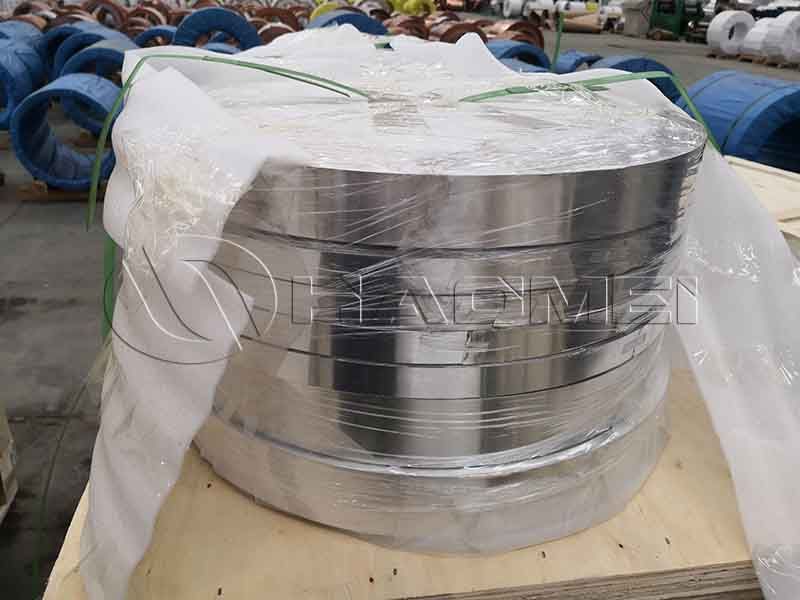
This has several practical implications:
Aluminum strip must be wider, thicker, or both, which can increase winding volume.
For compact transformers with limited core window space, copper strip is often better suited for high-power-density designs.
As conductor dimensions increase, the winding outer diameter may also increase. This can increase the average turn length and further affect winding losses.
In power-frequency transformers, foil windings are also affected by skin effect, proximity effect, leakage flux distribution, and other factors. In high-current, harmonic-rich, or high-frequency applications, conductor thickness, layer arrangement, and cooling design are especially important.
3. Weight
Although aluminum strip needs a larger cross-sectional area to achieve similar resistance, aluminum has a much lower density than copper. For similar resistance and current-carrying capability, an aluminum winding typically weighs only about 50% as much as an equivalent copper winding. This is one of aluminum's most significant advantages.
For large oil-immersed transformers, dry-type transformers, rectifier transformers, and equipment where transportation and lifting weight are important, aluminum windings can substantially reduce total equipment weight. Lower weight can also reduce requirements for enclosures, support structures, and lifting systems.
However, it is important to note that a lighter winding does not necessarily mean the total transformer weight will decrease by the same proportion. The core, insulation materials, clamping structures, tank, oil, radiators, and other components still account for a substantial share of the total weight.
4. Cost
Copper and aluminum prices fluctuate with global metal markets, but copper typically costs significantly more per kilogram than aluminum. Based purely on raw material price, aluminum strip is clearly less expensive.
However, transformer cost should be compared based on equivalent electrical performance, rather than price per kilogram alone.
Since aluminum requires only about half the weight of copper to achieve a similar DC resistance, its material-cost advantage is often even more pronounced. If copper costs several times more than aluminum, the total conductor cost of aluminum is usually much lower, even though a larger cross-sectional area is required.
4.1 Cost Advantages of Aluminum Strip
Aluminum strip typically offers the following cost benefits:
Lower raw material cost;
Lower conductor weight for equivalent electrical performance;
Significant reduction in conductor cost for large-capacity transformers;
Strong economic advantages in cost-sensitive and standardized products.
For this reason, aluminum winding is widely used in distribution transformers, general industrial transformers, and some dry-type transformers.
4.2 Aluminum Is Not Always Cheaper Overall
The cost advantage of aluminum may be partly offset by several factors:
A larger winding window may be required;
Core dimensions or coil support dimensions may need to increase;
A larger winding volume can increase insulation material usage;
Lead connections, welding, or crimping processes may be more complicated;
Greater attention is needed for oxidation protection, connection reliability, and quality control;
Designs requiring high efficiency, small size, or low temperature rise may become more complex and costly.
Therefore, aluminum's main advantages lie in conductor material cost and reduced weight, while copper's strengths lie in compact design, high efficiency, and connection reliability.
5. How Should You Choose Between Copper Strip and Aluminum Strip?
When Copper Strip Is the Better Choice
Copper strip is generally better suited for applications that require:
Smaller size and higher power density;
Higher efficiency and lower temperature rise;
Limited winding window space;
Greater mechanical strength and short-circuit withstand capability;
Complex terminal connections and high long-term reliability;
Premium, compact, or high-efficiency transformer designs.
When Aluminum Strip Is the Better Choice
Low-resistivity aluminum strip is generally suitable when:
Initial purchase cost is a major concern;
A modest increase in winding volume is acceptable;
Lower overall equipment weight is desired;
Transformer capacity is large and conductor cost represents a significant portion of total cost;
Transportation, installation, or lifting conditions are weight-sensitive;
Mature aluminum winding, connection, and quality-control processes are available.
Original source: https://www.alcustrip.com/a/aluminum-winding-strip-vs-copper-winding-strip-cost-conductivity-and-weight.html
Qoute Now
Contact Us
- Aluminum Strip for Argon Arc Welding
- Copper Metal Strip for Cable Armor
- Finished Product Rewinding Cable Aluminum Strip
- 1070 Aluminum Alloy Strip
- Color Coated Aluminium Strip Roll for Cable Armor
- Aluminum Strip Coil for Cable Shielding
- Wholesale 1050 Aluminum Strip Transformer Winding
- Interlocking Armoured Cable Aluminum Alloy Strip
- 1060 Alloy Aluminum Strip for Transformer
- Copper Strip for Electrical Transformer
- 1350 Aluminum Strip for Transformer
- Aluminum Strip for Cable Armor