
Bendable Copper Strips For Transformer
08.11.2026Copper strip is a core conductive material used in the manufacture of transformer winding, finding wide application in high- and low-voltage distribution transformers, power transformers, reactors, and other electrical equipment.
Compared to standard industrial copper products, the insulated copper strip designed specifically for transformers must meet more rigorous performance standards. Flexibility and bendability are critical factors determining winding quality and operational stability; meanwhile, precise thickness and width specifications directly influence electrical conductivity, insulation compatibility, and structural compactness—all essential for ensuring reliable equipment operation.
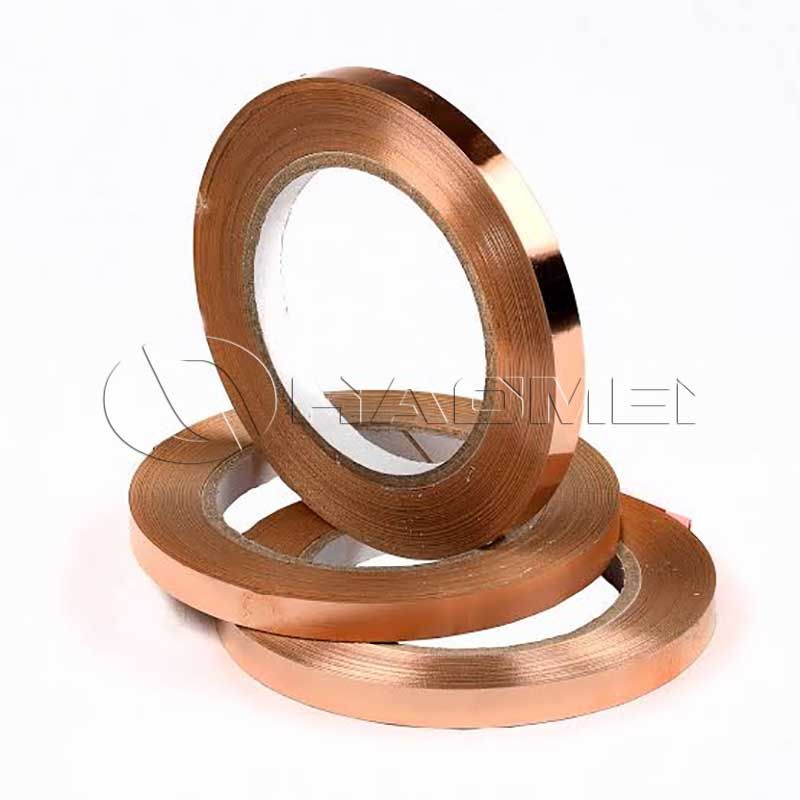
I. Flexibility and Bendability
Transformer winding is produced using a tight-winding process that requires the copper strip to undergo repeated bending, wrapping, and shaping to fit the transformer core. Consequently, excellent flexibility and bendability are indispensable properties; issues such as brittleness, cracking, or spring-back deformation are strictly prohibited, marking a key distinction from standard hard-temper copper strips.
Mainstream transformer copper strips in the industry utilize high-purity oxygen-free copper (grades TU1 and TU2) processed via O60 soft-temper annealing. This results in a soft, highly ductile material suitable for various winding conditions. Standardized testing requires that 0.5mm copper strips maintain a curvature of ≤3mm/m, ensuring uniform bending across the entire coil without localized hard spots.
Regarding bending performance, the material achieves a B·W bending ratio (R/t) of >2.0, allowing for multiple bends at small radii without surface cracking, wrinkling, or delamination. The internal conductive structure remains undeformed, ensuring stable electrical conductivity and mechanical strength.
Different types of transformer equipment have varying requirements for copper strip flexibility. Small distribution transformers involve tight winding radii and frequent bending, necessitating highly flexible strips to meet precise shaping needs.
Conversely, medium-to-large power transformers feature large winding spans and multiple layers; these require strips that balance flexibility with moderate rigidity—ensuring no spring-back after bending and a tight fit against the core to prevent winding looseness or displacement, thereby eliminating risks such as localized overheating or short circuits.
Furthermore, the edges of high-quality copper strips undergo precision processing to keep burrs within 0.03 mm; this prevents the insulation layer from being punctured during bending, thereby ensuring the safety of the transformer's insulation.
II. Thickness Specification Requirements
The thickness of the copper strip directly determines the transformer's current-carrying capacity and the heat dissipation efficiency of the windings. Excessive thickness deviation can lead to uneven current distribution and localized overheating, ultimately shortening the equipment's service life. The national standard GB/T18813-2014 establishes strict regulations regarding the thickness ranges and tolerances for transformer copper strips, with specific thickness specifications corresponding to different application scenarios.
The standard thickness range for transformer copper strips is 0.1 mm to 3.0 mm, with extremely high precision tolerances across all categories. Thin copper strips (0.1 mm–0.15 mm) have a thickness tolerance of ±0.005 mm and are primarily used for the precision windings of small, low-voltage transformers.
Specifications in the 0.15 mm–0.3 mm range (tolerance ±0.008 mm) and 0.3 mm–0.6 mm range (tolerance ±0.01 mm) are suitable for standard low-voltage distribution transformers. Thicker copper strips (0.8 mm–3.0 mm) are used for the low-voltage, high-current winding of medium- and high-voltage power transformers; their thickness tolerances are precisely controlled between ±0.010 mm and ±0.070 mm to avoid performance issues caused by uneven thickness. Copper strip 2mm is a popular thickness.
In engineering selection, low-voltage distribution transformers typically utilize 0.3 mm–2.0 mm copper strips, while medium-to-large-scale transformers for water conservancy and industrial power applications prioritize the use of thicker 0.8 mm–3.0 mm copper strips. Thickness increments are set at 0.05 mm or 0.10 mm, ensuring precise specifications that align perfectly with standardized winding designs.
III. Width Specification Requirements
The width of the copper strip determines the winding overlap width and the overall dimensions of the equipment. It must precisely match the iron core, insulation components, and equipment housing. As a key indicator for controlling the transformer's volume and structural compactness, it is subject to clear industry standards.
Based on mass-production applications and industry standards, copper strip widths fall into two main categories: thin strips (thickness < 0.5 mm) with a maximum width of 800 mm, and medium-to-thick strips (thickness 0.5 mm–2.5 mm) with a maximum width of 1,000 mm. Standard customized widths range from 5 mm to 600 mm, allowing for flexible adjustments based on transformer power ratings and winding configurations. Utilizing high-precision slitting technology, width tolerances are controlled within ±0.02 mm, ensuring smooth, burr-free, and deformation-free edges.
Copper strips of varying widths are suited to specific applications: narrow strips (5 mm–100 mm) are ideal for small and micro-transformers and reactors, offering ease of winding and compact structural design; medium-width strips (100 mm–600 mm) are the standard choice for industrial and residential distribution transformers, enabling uniform, large-area winding that enhances electrical conductivity; and extra-wide strips are primarily used in the custom production of large industrial transformers, effectively minimizing winding seams, reducing contact resistance, and improving overall equipment performance.
Original source: https://www.alcustrip.com/a/bendable-copper-strips-for-transformer.html
Qoute Now
Contact Us
- Copper Strip for Electrical Transformer
- 1060 Alloy Aluminum Strip for Transformer
- Wholesale 1050 Aluminum Strip Transformer Winding
- Aluminum Strip for Cable Armor
- Finished Product Rewinding Cable Aluminum Strip
- Aluminum Strip for Argon Arc Welding
- Color Coated Aluminium Strip Roll for Cable Armor
- Copper Metal Strip for Cable Armor
- 1350 Aluminum Strip for Transformer
- 1070 Aluminum Alloy Strip
- Interlocking Armoured Cable Aluminum Alloy Strip
- Aluminum Strip Coil for Cable Shielding