
How Aluminum Strip Conductivity Affects Transformer Efficiency
07.20.2026Transformers are the core of power transmission and distribution, and their efficiency directly affects the energy consumption and cost of the power system. As the core of power transmission, the conductivity of the aluminum strip used in the winding is crucial in determining the transformer's losses, efficiency, and stability.
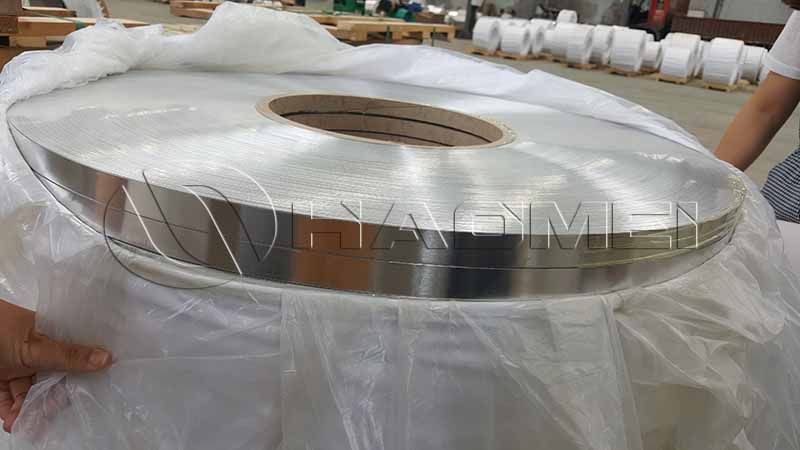
Conductivity Requirements for Aluminum Strips for Transformer
Different operating environments, power ratings, and voltage levels require different aluminum strip conductivity, but there are industry-wide standards that balance conductivity, mechanical properties, and processing performance.
International standards require that the conductivity of aluminum strips used in transformers be no less than 61% IACS (20℃), corresponding to a resistivity ≤0.0283 Ω·mm²/m. Medium-sized and large-voltage transformers have higher conductivity requirements, with some high-end products requiring 62%~63% IACS to reduce aluminum losses.
It is important to note that higher aluminum strip conductivity is not always better. Excessively high conductivity relies on high-purity aluminum, which can lead to decreased hardness and strength, making it prone to deformation and breakage during winding and assembly. Therefore, a balance must be struck between conductivity and mechanical properties to meet the requirements of "low loss, easy processing, and high stability."
Eddy Current Loss
Besides resistive losses, the conductivity of the aluminum strip also affects eddy current losses, thus impacting transformer efficiency. Eddy current losses are closely related to the conductivity, thickness, and magnetic flux density distribution of the aluminum strip, and are an unavoidable form of loss during operation.
During transformer operation, the alternating magnetic field of the core induces eddy currents in the aluminum strip. These eddy currents generate Joule heat, resulting in losses. The magnitude of these losses is directly proportional to the aluminum strip's conductivity, the square of its thickness, the magnetic field frequency, and the square of its magnetic flux density. Excessively high conductivity increases eddy current losses, while excessively low conductivity increases aluminum losses; therefore, proper control is necessary.
This requires that during design, while selecting high-conductivity aluminum strips to reduce aluminum losses, eddy currents should be suppressed by optimizing the strip thickness and using segmented windings, balancing these two types of losses to minimize overall losses.
1350 and 1070 Aluminum Strips
1350 and 1070 aluminum strips are the mainstream aluminum strip models used in transformers. Both are industrial-grade pure aluminum with excellent conductivity, differing slightly in purity and performance to suit different applications.
1. 1350 Aluminum Strip
1350 is a special aluminum strip for electrical engineering, with an aluminum purity ≥99.5% and a conductivity of 61%~62% IACS at 20℃, meeting core standards and making it one of the preferred materials for transformer windings.
1350 aluminum alloy offers stable performance, a controllable temperature coefficient of resistance, a uniform surface oxide film, and minimal contact resistance fluctuations, making it suitable for medium to large-sized, high-voltage transformers and export equipment, offering excellent cost-effectiveness.
2. 1070 Aluminum Strip
1070 is high-purity pure aluminum, with an aluminum purity ≥99.7% and a conductivity of 62%~63% IACS at 20℃. Its conductivity is superior to 1350, with lower aluminum losses.
1070 aluminum strip is suitable for high-current applications such as high-voltage substations, reducing energy consumption. However, it has slightly lower strength, is more prone to deformation, and is more expensive, making it more suitable for high-end or precision transformers.
3. Comparison and Selection Recommendations
Selection Recommendations: For high conductivity and low loss, choose 1070; for stable performance, easy processing, and cost-effectiveness, 1350 is the mainstream choice and is suitable for most common scenarios.
Original source: https://www.alcustrip.com/a/how-aluminum-strip-conductivity-affects-transformer-efficiency.html
Qoute Now
Contact Us
- Copper Strip for Electrical Transformer
- 1060 Alloy Aluminum Strip for Transformer
- Wholesale 1050 Aluminum Strip Transformer Winding
- Aluminum Strip for Cable Armor
- Finished Product Rewinding Cable Aluminum Strip
- Aluminum Strip for Argon Arc Welding
- Color Coated Aluminium Strip Roll for Cable Armor
- Copper Metal Strip for Cable Armor
- 1350 Aluminum Strip for Transformer
- 1070 Aluminum Alloy Strip
- Interlocking Armoured Cable Aluminum Alloy Strip
- Aluminum Strip Coil for Cable Shielding