
What Is the Best Aluminum Strip for Transformers
07.14.2026Aluminum strip, a common material for core components such as transformer winding and heat dissipation structures, is gradually replacing some copper applications due to its advantages such as lightweight, low cost, and good electrical and thermal conductivity. So how do you choose the right aluminum strip alloy?
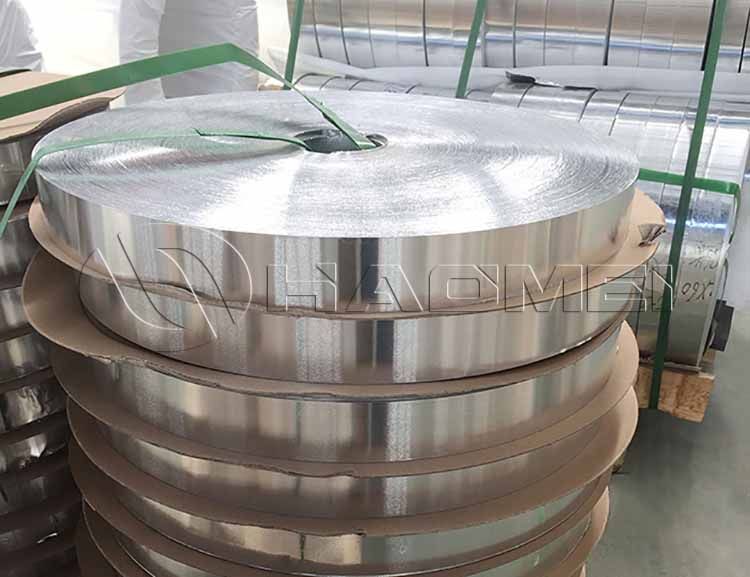
Core Requirements for Aluminum Strip for Transformers
Firstly, electrical conductivity. The transformer winding is responsible for transmitting electrical energy; higher conductivity results in lower energy losses (eddy current losses, resistive losses) and higher operating efficiency.
Secondly, mechanical strength. Aluminum winding strip for transformers needs to withstand the tension and bending during winding and assembly, as well as the vibrations during transformer operation, requiring certain tensile strength and toughness.
Thirdly, corrosion resistance. Transformers operate in complex environments, and some outdoor and humid environments place specific requirements on the corrosion resistance of aluminum strip.
Finally, processing performance. Good ductility and formability reduce the difficulty of winding and welding processes, improving production efficiency.
Mainstream Alloy Comparison
1. 1-Series Pure Aluminum Strip (1060, 1070)
1-Series pure aluminum strip is the most widely used type of aluminum strip for transformers. Among them, the 1060 alloy is recognized in the industry as "transformer-specific aluminum strip" and is the alloy type we highly recommend.
In terms of composition, the 1060 aluminum strip for transformers has an aluminum content of over 99.6%, belonging to high-purity pure aluminum. It contains only trace amounts of impurities such as iron and silicon, and almost no other alloying elements, which determines its core advantages.
In terms of conductivity, the 1060 pure aluminum strip has a conductivity of up to 61% IACS, which is the best conductivity among all commonly used aluminum strip alloys, second only to pure copper.
For transformer winding, high conductivity means that resistance loss and eddy current loss can be minimized during power transmission, effectively improving the transformer's operating efficiency, while reducing equipment heat generation and extending service life.
Especially for dry-type transformers, whose windings are directly exposed to air, the requirements for loss and heat generation control are even higher, making the 1060 aluminum strip particularly suitable.
2. 3-Series Aluminum-Manganese Alloy Strip (3003)
Compared to 1-series pure aluminum, 3003 aluminum strip has an optimized alloy composition that improves mechanical strength and corrosion resistance. Its conductivity is slightly lower, around 40% IACS, which, while not as good as 1060, is still sufficient for some non-core conductive components in transformers.
3. 5-Series Aluminum-Magnesium Alloy Strip (5052)
The conductivity of 5052 aluminum strip is only around 35% IACS, far lower than 1060 and 3003. Its insufficient conductivity makes it completely unsuitable for windings, leads, and other conductive components.
However, in some special transformer applications, 5052 aluminum strip can be used for structural components subjected to high stress, such as the frames and supports of large outdoor transformers, or the casings and connectors of transformers in corrosive environments like coastal or chemical plants. These components require high mechanical strength and corrosion resistance but have no special requirements for conductivity, allowing the advantages of 5052 aluminum strip to be fully utilized.
How to choose it
1. Core Components (Windings, Leads): 1060 pure aluminum strip is the preferred choice. Its high conductivity reduces power loss and improves transformer efficiency. It also offers good processing performance and low cost, making it the most cost-effective option. If higher purity and conductivity are required, 1070 pure aluminum strip (aluminum content above 99.7%) can be used, offering slightly better performance than 1060, but at a slightly higher cost.
2. Heat Dissipation Components (Heat Heatsinks, Heat Pipes): 3003 aluminum-manganese alloy strip is the preferred choice. It balances thermal conductivity and mechanical strength, has good corrosion resistance, is suitable for transformer heat dissipation requirements, and has moderate processing difficulty.
3. Special Structural Components (Frames, Brackets, Corrosive Environment Shells): 5052 aluminum-magnesium alloy strip is used. Its high strength and excellent corrosion resistance meet the structural requirements of special scenarios. Although it is more difficult to process and more expensive, it has strong adaptability.
Original source: https://www.alcustrip.com/a/what-is-the-best-aluminum-strip-for-transformers.html
Qoute Now
Contact Us
- Copper Strip for Electrical Transformer
- 1060 Alloy Aluminum Strip for Transformer
- Wholesale 1050 Aluminum Strip Transformer Winding
- Aluminum Strip for Cable Armor
- Finished Product Rewinding Cable Aluminum Strip
- Aluminum Strip for Argon Arc Welding
- Color Coated Aluminium Strip Roll for Cable Armor
- Copper Metal Strip for Cable Armor
- 1350 Aluminum Strip for Transformer
- 1070 Aluminum Alloy Strip
- Interlocking Armoured Cable Aluminum Alloy Strip
- Aluminum Strip Coil for Cable Shielding