
Key Specifications When Buying C1100 Copper Strip for Transformers
10.21.2026Copper strips used for transformer windings, leads, and shielding components must meet stringent requirements regarding electrical conductivity, formability, and insulation reliability. When procuring these materials, one should not focus solely on the price of copper or the thickness; instead, specifications such as the material grade, temper (hardness state), dimensional tolerances, edge quality, and quality certification documents must be incorporated into the technical procurement agreement. Key parameters to verify when purchasing C1100 copper strips are outlined below.
I. Grade and Chemical Composition
C1100 copper strip is a pure copper grade within the JIS (Japanese Industrial Standards) system, typically corresponding to electrolytic tough-pitch copper, with a copper-plus-silver (Cu+Ag) content of no less than 99.90%. Procurement documents should explicitly specify the "C1100" grade and reference the applicable standard—such as JIS H3100 or a mutually agreed-upon corporate standard.
For high-frequency transformers, foil winding, or products sensitive to power loss, particular attention should be paid to oxygen content and impurity levels to ensure that batch-to-batch variations do not adversely affect electrical conductivity, weldability, or the effectiveness of subsequent insulation varnish impregnation.
II. Tempers
The temper of a copper strip determines its hardness, elongation, and bending characteristics. Common tempers include O (annealed/soft), 1/4H, 1/2H, and H (hard). For copper strips used in transformer coil windings—or those requiring bending or stamping—an O or 1/4H temper is generally preferred.
For structural components that require greater rigidity and resistance to deformation, a 1/2H or H temper may be chosen. To avoid discrepancies in how different suppliers define these states, procurement agreements should specify precise ranges for hardness, tensile strength, and elongation, rather than relying on vague terms like "soft" or "hard."
III. Electrical Conductivity Requirements
Electrical conductivity is directly related to the DC resistance of the windings, copper losses, and temperature rise. It is typically expressed as a percentage of the International Annealed Copper Standard (%IACS), with measurements standardized at a temperature of 20°C. The actual electrical conductivity of C1100 copper strip typically reaches 98%–101% IACS; the exact value depends on raw material purity, processing state, and the testing method employed.
For standard power transformers, a minimum conductivity threshold can be specified in the technical agreement. For low-loss, precision, or high-frequency applications, it is advisable to set higher requirements and mandate that the supplier provide test data for each batch. It should be noted that the term "pure copper" alone is insufficient to determine electrical conductivity; one must rely on formal test reports.
IV. Thickness, Width, and Tolerances
The thickness and width of the tight tolerance copper alloy strip must align with the winding design, insulation clearances, and the equipment's tensioning system. Procurement specifications should clearly define nominal dimensions, plus/minus tolerances, transverse thickness variation, and thickness consistency throughout the coil.
For thin-gauge copper strips, in particular, thickness uniformity is critical; otherwise, it may lead to uneven turn-to-turn height, inconsistent winding tension, or localized overheating. Regarding width, in addition to tolerances, attention should be paid to camber, wavy edges, and lateral curvature to ensure they do not interfere with automated winding or lamination assembly processes.
V. Edge Condition and Burr Control
Since transformer copper strips frequently come into contact with insulating paper, films, or enameled materials, edge quality is of paramount importance. Edge specifications may be defined as slit, rounded, deburred, or chamfered. For designs with thin insulation, it is recommended to use deburred or rounded-edge copper strips to minimize the risk of puncturing the insulation layer.
Maximum allowable burr height should be established based on the copper strip thickness, insulation class, and winding method. Furthermore, the inspection orientation must be specified: slit edges often feature burrs on both sides, so both must be examined during acceptance. If the product is intended for high-speed automated winding, it is also necessary to control edge defects such as edge collapse, cracking, or serrated edges.
VI. Coil Inner Diameter and Coil Weight
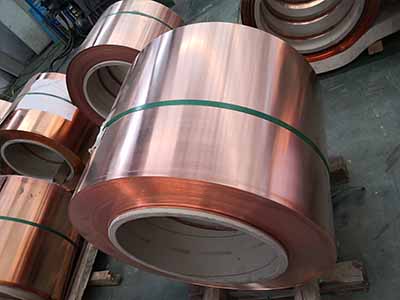
The inner diameter of the coil must be compatible with the client’s dereeling stands, winding equipment, and handling fixtures. Common inner diameters include 300 mm, 400 mm, and 500 mm. The weight of each coil should be determined based on the equipment's load-bearing capacity, the frequency of coil changes, and on-site handling conditions. Coils that are too heavy increase the risks during loading, while those that are too light reduce production efficiency.
Procurement contracts should also specify the allowable range for coil diameters, requirements for joints (splices), and the permitted deviation in the net weight of each coil. For copper strips used in continuous winding processes, the number of joints should be minimized; for critical winding materials, it may be specified that "no joints are permitted" or that "the number of joints per coil shall not exceed an agreed-upon limit."
VII. Surface Cleanliness
The surface of the copper strip must be smooth and clean, free from oil, water stains, oxidation spots, indentations, scratches, black marks, and noticeable color variations. This is particularly important for areas intended for welding, tin-plating, varnish impregnation, or bonding, as residual surface oil can impair adhesion and increase contact resistance.
During procurement, one may specify materials with low-residual-oil or oil-free packaging, and mandate that the surface be free from any oxidation that could interfere with its intended use. For high-reliability transformers, it is advisable to include requirements for periodic surface cleanliness inspections, packaging integrity, and moisture protection.
VIII. Certificates and Quality Documentation
Each batch of C1100 copper strip must be accompanied by a material certificate or Certificate of Analysis (COA). This documentation should include, at a minimum, the material grade, heat number, batch number, chemical composition, electrical conductivity, mechanical properties, dimensional inspection results, and weight information.
If the product is intended for export, or subject to electrical safety or environmental regulations, additional documentation—such as RoHS and REACH compliance statements, halogen-free declarations, and certificates of origin—may be required. For critical projects, it is recommended that suppliers provide an ISO 9001 quality management system certificate and third-party test reports, while also establishing a traceable link between the heat number, coil number, and the final product batch.
In summary, the procurement of C1100 copper strips for transformers should be governed by a comprehensive technical specification covering five key dimensions: electrical conductivity, dimensions, edge quality, surface cleanliness, and traceability. By incorporating these critical parameters into contracts and acceptance criteria, manufacturers can effectively mitigate risks related to winding defects, insulation damage, and fluctuations in electrical performance.
Original source: https://www.alcustrip.com/a/key-specifications-when-buying-c1100-copper-strip-for-transformers.html
Qoute Now
Contact Us
- Aluminum Strip for Argon Arc Welding
- Copper Metal Strip for Cable Armor
- Finished Product Rewinding Cable Aluminum Strip
- 1070 Aluminum Alloy Strip
- Color Coated Aluminium Strip Roll for Cable Armor
- Aluminum Strip Coil for Cable Shielding
- Wholesale 1050 Aluminum Strip Transformer Winding
- Interlocking Armoured Cable Aluminum Alloy Strip
- 1060 Alloy Aluminum Strip for Transformer
- Copper Strip for Electrical Transformer
- 1350 Aluminum Strip for Transformer
- Aluminum Strip for Cable Armor