
Standards and Specifications For Transformer Copper Strip
07.07.2026Transformer Cu strip uses electrolytic copper (ETP) as its core base material, relying on high-purity copper to achieve low electrical resistance. Industry mainstream grades have fixed correspondences in global standards, which are also the basic prerequisites for specification selection:
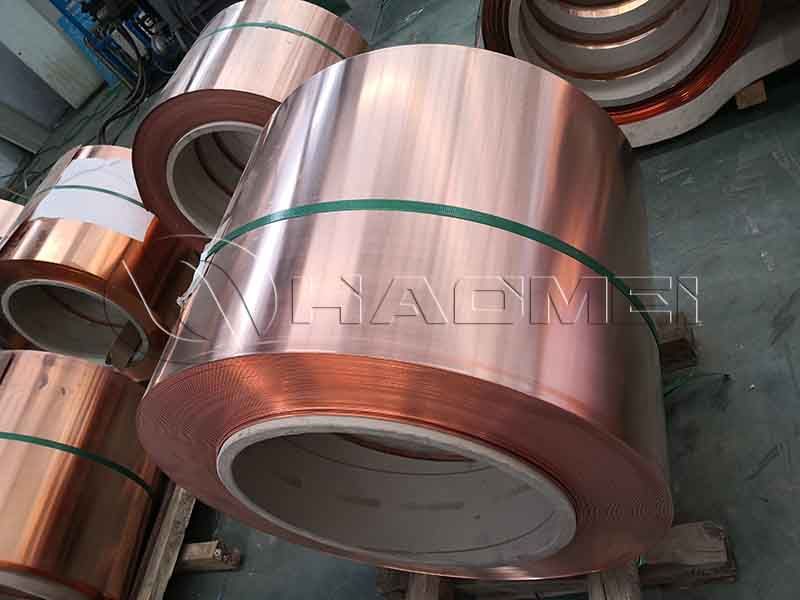
- National Standard GB: T2 copper (copper content ≥99.90%)
- ASTM: C11000 (electrolytic electrolytic copper, the most common grade in the industry)
- EN: CW004A / Cu-ETP (European electrical grade electrolytic copper)
- IEC: E-Cu 58 (electrical grade copper, specifying the minimum conductivity standard)
- JIS: C1100 (Japanese electrical grade copper strip, suitable for Japanese transformer systems)
All transformer-specific copper strips require low oxygen content (typically 0.02%~0.04%) to prevent conductivity degradation and welding cracking caused by oxygen enrichment. This is a core characteristic that distinguishes it from ordinary decorative and mechanical copper strips.
Core Differences of the Four International Standards
All four standards regulate the chemical composition, mechanical properties, electrical properties, and dimensional tolerances of transformer copper strips, but their applicable regions and emphases differ, directly impacting the compliance of material selection in cross-border projects.
1. ASTM Standard (North American System)
Core Basis: ASTM B152/B152M (General Specification for Flat Copper) + ASTM B98 (Specific Requirements for Electrical Copper Strip)
- Core Grade: C11000 is the only mainstream selection, strictly limiting the total copper + silver content to ≥99.90% and oxygen content to ≤0.05%;
- Conductivity Standard: Default ≥100% IACS, high-performance transformer-grade copper strips can reach 101% IACS and above;
- Tolerance Characteristics: Uses imperial units for classification, thickness tolerance is divided according to coil width and thickness range, with stricter control over the thickness tolerance of high-voltage winding copper strips;
- Applicable Scenarios: Distribution transformers and main power transformers in North America, compatible with NEMA electrical systems.
2. EN Standard (EU System)
Core Basis: EN 13601 (General Standard for Copper Rods and Strips for Electrical Use), a mandatory harmonized standard in the European Union.
- Core Grade: Cu-ETP (CW004A), clearly distinguishing between electrical and industrial grade copper materials, prohibiting their mixing;
- Performance Requirements: Mandatory minimum conductivity of 58 MS/m (corresponding to the origin of the E-Cu 58 designation), mechanical properties differentiated between O-state (soft) and 1/2H-state (semi-hard), adaptable to different winding processes;
- Tolerance Characteristics: Metric-based fine-grained classification, side curvature and edge burr indicators are stricter than ASTM, emphasizing the process adaptability of winding;
- Applicable Scenarios: Power projects throughout the EU, the Middle East, Africa, etc., adopting the European standard system.
3. IEC Standards (Internationally Accepted Benchmarks)
Core Basis: IEC 60287-1-1 (Electrical properties of cables and conductors) + IEC 60889 (Specification for copper strips for windings), serving as the global benchmark.
- Core Positioning: Does not mandate regional compliance, unifies basic global electrical copper material specifications, and serves as the benchmark for ASTM, EN, and JIS.
- Key Indicators: Defines IACS conductivity benchmarks, basic thresholds for thickness/width tolerances, and criteria for judging surface defects.
- Process Guidance: Focuses on specifying the structural and performance requirements of special transformer copper strips such as continuously transposed copper strips (CTC).
- Value: A universal acceptance benchmark for multinational projects, resolving the issue of benchmarking between different regional standards.
4. JIS Standard (Japan/East Asia System)
Core Basis: JIS H3100 (Copper and Copper Alloy Plates and Strips) + JIS C2521 (Special Standard for Copper Materials for Electrical Windings)
- Core Grade: C1100, chemical composition basically aligned with ASTM C11000, but with higher precision in impurity control;
- Performance Characteristics: Default conductivity ≥100% IACS, optimized for the tolerances of thin-gauge copper strips (0.1~0.5mm) for Japanese compact transformers;
- Quality Control Focus: Emphasis on controlling surface micro-scratches and edge rounding accuracy, suitable for precision automated winding equipment;
- Applicable Scenarios: Japanese transformers, Southeast Asian supporting projects, high-end precision power distribution equipment.
Transformer Copper Strip Core Specifications
Items | General range | Tempers | Uses |
Thickness | 0.10mm ~ 2.50mm | O, 1/2H | Thin strip (0.1~0.4mm): Small distribution transformer; Thick strip (0.5~2.5mm): High-voltage main transformer |
Width | 14mm ~ 650mm | O | Narrow copper strip: Segmented winding; Wide copper strip: Integral high-capacity winding |
Side curvature | ≤2mm/m (universal threshold across all standards) | \ | Ensures smooth winding and avoids localized stress on the winding. |
Edge burrs | ≤0.01mm | \ | To prevent puncturing the insulation paper and avoid inter-turn short circuits |
Three Core Customization Requirements from Customers
Standards serve as the basic baseline. End customers will propose stringent customized requirements based on the transformer's voltage level and energy efficiency rating. Conductivity, dimensional tolerances, and surface finish are key rejection criteria.
1. Conductivity Requirements
Conductivity directly determines transformer load loss and is a key indicator for energy efficiency certification. Customer requirements are generally higher than the standard baseline values:
- Conventional Energy Efficiency Transformers: ≥100% IACS (meets the basic requirements of the four major standards);
- Level 1 Energy Efficiency/High-Voltage Main Transformers: ≥101% IACS, requiring copper purity ≥99.95%, and strict control of harmful impurities such as phosphorus and iron (total impurities ≤0.05%);
- Testing Requirements: Customers typically require conductivity testing of each coil according to IEC 60287, and the provision of material analysis reports, rejecting batch-to-batch performance deviations.
2. Dimensional Tolerances
Exceeding tolerances can lead to uneven winding overlap and insulation damage due to stress. Customers will tighten the tolerance range beyond the standard:
- Thickness Tolerance: Standard ±0.03mm, high-end customers tighten to ±0.01~±0.02mm; thin strip (<0.4mm) uses cold rolling finishing process, with tolerance strictly controlled within ±0.005mm;
- Width Tolerance: General ±0.5mm, ±0.1mm required for automatic winding equipment to avoid winding misalignment;
- Edge Quality: Mandatory burr-free and crack-free, edges are rounded, burr height strictly ≤0.01mm, eliminating the risk of insulation breakdown.
3. Surface Finish
The flexible copper strip surface is in direct contact with the insulating paper and varnish. Surface defects are a major cause of inter-turn short circuits. Our customers have the most meticulous quality control requirements:
- Prohibited Defects: No oxidation spots, no longitudinal scratches, no roller marks, no pinholes; surface roughness Ra≤0.8μm;
- Oxidation Control: Requires a uniformly bright surface, no localized blackening, no oxide layer on the coil end face, and sealed moisture-proof packaging before shipment;
- Process Requirements: High-end projects require no residual rolling oil on the surface to avoid oil carbonization affecting insulation performance after long-term operation.
Original source: https://www.alcustrip.com/a/standards-and-specifications-for-transformer-copper-strip.html
Qoute Now
Contact Us
- Copper Strip for Electrical Transformer
- 1060 Alloy Aluminum Strip for Transformer
- Wholesale 1050 Aluminum Strip Transformer Winding
- Aluminum Strip for Cable Armor
- Finished Product Rewinding Cable Aluminum Strip
- Aluminum Strip for Argon Arc Welding
- Color Coated Aluminium Strip Roll for Cable Armor
- Copper Metal Strip for Cable Armor
- 1350 Aluminum Strip for Transformer
- 1070 Aluminum Alloy Strip
- Interlocking Armoured Cable Aluminum Alloy Strip
- Aluminum Strip Coil for Cable Shielding