
What Are Uses Of The Rerolled Copper Alloy Strip
09.01.2026The rerolled coppre alloy strip is a high-precision material produced through refined processing techniques—such as secondary precision rolling, alloy modification, and temperature-controlled annealing—building upon the foundation of conventional rolled copper strip.
Unlike standard single-pass rolled copper strip, it utilizes pure copper or copper alloys (such as Cu-Cr, Cu-Sn, or Cu-Zn) as the base material. It undergoes precision shaping via multi-pass reversible precision rolling mills, offering a wide controllable thickness range (with mainstream specifications between 0.08 mm and 1.0 mm) and extremely tight dimensional tolerances; its surface flatness and material density far surpass those of ordinary copper strip.
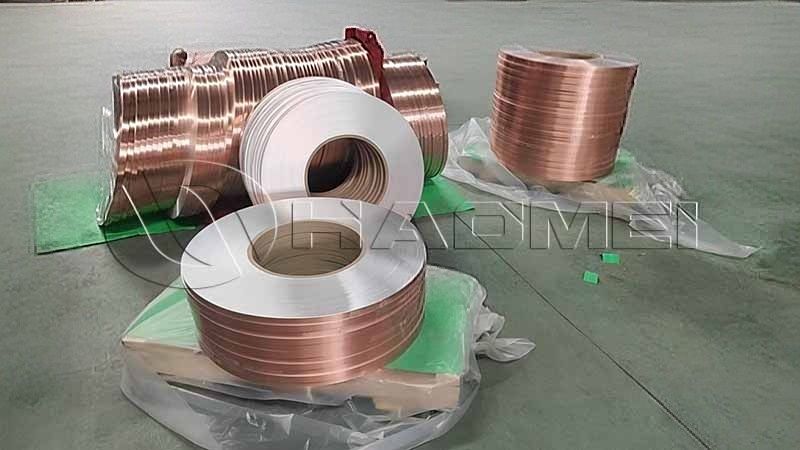
By combining the re-rolling process with optimized alloy formulations, the material perfectly preserves copper's inherent superior electrical and thermal conductivity while significantly enhancing tensile strength, softening resistance, corrosion resistance, and fatigue resistance.
With excellent plasticity and bending adaptability, it meets the demands of high-precision, high-load, and long-service-life industrial applications. As a high-end, premium copper-based material, it is widely suited for precision manufacturing and critical power infrastructure sectors.
The power industry is the primary application field for re-rolled copper alloy strip. Thanks to its outstanding conductivity, structural adaptability, and stability, it plays an irreplaceable role in transformer winding and cable armoring, serving as a key material for the upgrading of power equipment.
1. Transformer Winding
While traditional transformers often used round copper wire for winding, modern high- and low-voltage transformers, dry-type transformers, and specialized transformers for new energy applications have largely shifted to using re-rolled copper alloy strip. The flat, thin-strip structure created by the re-rolling process allows for a more orderly and compact winding arrangement. Compared to round copper wire, this significantly improves internal space utilization, minimizes gaps between winding layers, and reduces the overall volume of the equipment.
In terms of performance, the material offers stable conductivity and uniform electrical resistance, effectively reducing energy loss during transformer operation and enhancing power transformation efficiency. Furthermore, copper alloy strips subjected to heavy-rolling and annealing treatments exhibit superior high-temperature and aging resistance.
They resist deformation and softening during prolonged, high-load operations, thereby significantly enhancing the operational stability and service life of transformers. They are perfectly suited for a wide range of applications, including industrial power grids, transformer equipment for photovoltaic and wind power systems, and civil power distribution transformers.
2. Cable Armoring
Cable armoring serves as the primary protective structure for cables, designed to withstand external crushing, tensile forces, and abrasion while enhancing resistance to moisture, corrosion, and electromagnetic interference. Heavy-rolled copper alloy strip is a premium material choice for high-end cable armoring.
Compared to standard steel or copper strip armoring, heavy-rolled copper alloy strips offer uniform texture and exceptional toughness. They provide superior conformability, wrapping tightly around the cable core to ensure comprehensive protection without vulnerable gaps. Their excellent corrosion resistance effectively withstands acid and alkali exposure—whether in underground installations, humid environments, or chemical processing conditions—preventing rust and damage to the armor layer.
Additionally, the copper-based material offers effective electromagnetic shielding, blocking external interference to ensure stable power transmission and signal integrity for high-voltage, communication, and rail transit cables. Its high tensile strength allows it to withstand the pulling forces encountered during installation as well as long-term geological stress, drastically reducing the risk of cable damage or failure and enhancing overall transmission safety.
Other Key Applications of Rolled Copper Alloy Strips
Beyond core power applications, heavy-rolled copper alloy strips leverage their comprehensive performance advantages to serve diverse sectors—including electronics manufacturing, new energy, and high-end equipment—demonstrating exceptional versatility.
1. Electronic Component Manufacturing: Thanks to high dimensional precision and excellent stamping formability, these thin copper strips can be processed into semiconductor lead frames, precision connectors, conductive switch springs, and PCB copper-clad substrates. They are ideal for high-end electronic products such as 5G communication devices, smart home appliances, and industrial control equipment, ensuring stable electrical conductivity and a long service life for the components.
2. New Energy Vehicle Sector: Commonly used to manufacture power battery connection tabs, conductive connectors for high-voltage wiring harnesses, and heat dissipation components for vehicle electrical systems. The material combines high electrical conductivity, superior thermal conductivity, and vibration resistance, enabling it to withstand complex operating conditions and ensure the stable performance of the vehicle's power system.
3. Industrial Control and Electrical Equipment: Used to fabricate flexible conductive straps and copper grounding busbars for high- and low-voltage switchgear and distribution boxes. These components offer excellent flexibility and conductivity, accommodating the relative movement of equipment parts while ensuring safe grounding and efficient electrical conduction.
4. Precision Heat Dissipation Components: Leveraging ultra-high thermal conductivity, the material can be processed into various precision heat sinks and heat dissipation substrates. It is widely used in thermal management systems for power electronics, precision instruments, and photovoltaic equipment, facilitating rapid heat dissipation to prevent equipment malfunctions caused by overheating.
Original source: https://www.alcustrip.com/a/what-are-uses-of-the-rerolled-copper-alloy-strip.html
Qoute Now
Contact Us
- Copper Strip for Electrical Transformer
- 1060 Alloy Aluminum Strip for Transformer
- Wholesale 1050 Aluminum Strip Transformer Winding
- Aluminum Strip for Cable Armor
- Finished Product Rewinding Cable Aluminum Strip
- Aluminum Strip for Argon Arc Welding
- Color Coated Aluminium Strip Roll for Cable Armor
- Copper Metal Strip for Cable Armor
- 1350 Aluminum Strip for Transformer
- 1070 Aluminum Alloy Strip
- Interlocking Armoured Cable Aluminum Alloy Strip
- Aluminum Strip Coil for Cable Shielding