
Aluminium Strip For Transformer Winding
09.14.2026Aluminium conductors can reduce winding weight and material cost, but the specification must control electrical resistance before comparing a quoted unit price. For transformer manufacturers, conductivity is the product feature that most directly affects winding loss, temperature rise, and finished-equipment efficiency.
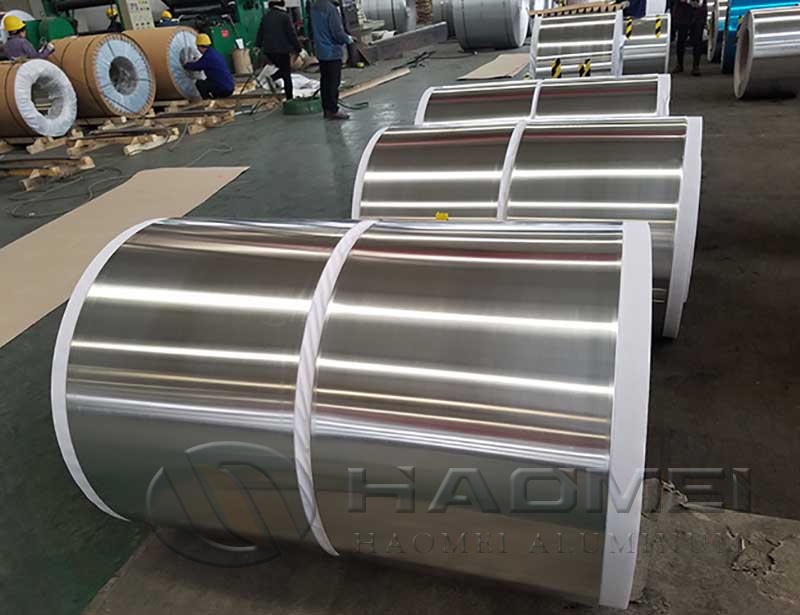
An aluminium winding conductor should not be selected by alloy name alone. Alloy chemistry, temper, thickness tolerance, burr condition, and surface cleanliness all influence coil production. The most practical approach is to define measurable acceptance criteria before production starts.
Specify Conductivity Before Comparing Alloy Prices
Electrical conductivity is commonly reported as %IACS, the International Annealed Copper Standard. By definition, 100% IACS corresponds to annealed copper conductivity of 58.0 MS/m at 20°C. A material rated at 61% IACS therefore has conductivity of approximately 35.38 MS/m and resistivity near 0.02826 Ω·mm²/m at 20°C.
For a DC winding section, resistance can be estimated as:
R = ρL / A
Where ρ is resistivity, L is conductor length, and A is cross-sectional area. Lower resistance reduces I²R loss. However, the completed transformer also has AC, proximity, eddy-current, joint, and thermal effects. A strip certificate alone cannot prove finished-transformer efficiency.
EU Ecodesign Regulation (EU) No 548/2014, as amended by Regulation (EU) 2019/1783, sets loss-related requirements for certain power transformers placed on the EU market. The regulation applies to the finished transformer, not to incoming conductor material. It nevertheless makes consistent winding resistance control more important for manufacturers serving regulated power-equipment markets.
| Alloy option | Typical aluminum minimum by designation | Common suitability | What to verify on the certificate |
|---|---|---|---|
| 1050 / 1050A | 99.50% Al | General electrical winding applications | Conductivity, Fe + Si limits, temper |
| 1060 | 99.60% Al | Winding where high purity and formability are required | Actual %IACS, thickness, edge condition |
| 1070 | 99.70% Al | High-purity conductor applications | Mechanical strength after annealing |
| 1350 | 99.50% Al | Electrical conductor-grade applications | %IACS test method and lot traceability |
Chemical composition requirements for wrought aluminum designations are covered by standards such as EN 573-3 and Aluminum Association alloy registration data. Composition alone does not establish a guaranteed conductivity value. Put the minimum conductivity requirement directly into the purchase specification, including test temperature and test method.
For applications requiring conductor-grade chemistry, specify 1350 Aluminum Strip for Transformer with a stated minimum %IACS value rather than accepting an unqualified "high conductivity" claim. If 1050 is selected for cost and availability, the product description for Wholesale 1050 Aluminum Strip Transformer Winding should be matched against the winding drawing and insulation system.
Control Dimensions, Edges, and Surface for Stable Winding
A conductivity result is only useful when every turn can be wound without insulation damage or unstable coil build. Edge burr is especially important because sharp metal projections can cut paper, film, enamel, or interlayer insulation during tensioned winding.
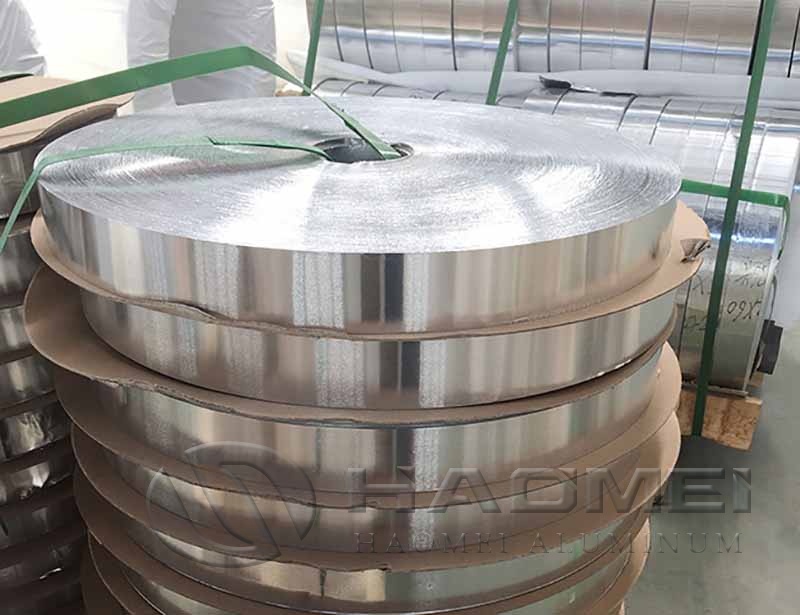
Use the following specification checklist for each ordered size:
Thickness and width: State nominal dimensions and permitted tolerance. EN 485-4 provides dimensional tolerances for cold-rolled aluminum and aluminum-alloy flat products; confirm that the selected tolerance class matches the winding machine capability.
Temper: Identify the required temper, such as O for annealed material. Do not assume all soft material has identical elongation or springback.
Edge condition: Define slit edge, deburred edge, or an agreed burr limit. Inspect both sides of the strip, not only the upper edge.
Surface: Require a clean, dry surface without rolling-oil excess, embedded particles, oxidation staining, scratches, or handling damage that could affect insulation adhesion.
Coil geometry: State inside diameter, outside diameter, maximum coil mass, winding direction, and allowable telescoping. These details prevent line stoppages at the decoiler.
Joints and traceability: State whether welds are permitted. Require a coil identifier tied to the material test certificate.
| Production issue | Likely strip-related cause | Practical control |
|---|---|---|
| Insulation puncture during winding | Burrs or sharp slit edge | Agree edge standard and inspect samples under magnification |
| Uneven coil build | Width variation, camber, telescoping | Set width tolerance and coil-shape limits |
| Resistance above design value | Conductivity below requirement or thickness deviation | Verify %IACS and measure cross-section |
| Excessive springback | Temper not suited to winding tension | Approve temper using a trial coil |
| Poor varnish or insulation interaction | Surface contamination | Require clean surface and compatibility trial |
Use a Verifiable Incoming-Inspection Plan
Before regular production, obtain a representative sample from the intended production route, not an unrelated stock sample. Measure thickness at multiple points across the width and at the head, middle, and tail of the coil. Record width, camber, burr orientation, hardness or temper evidence, and surface condition.
For conductivity, request a material test certificate stating the reported value, test method, and reference temperature. Eddy-current instruments can provide fast comparative checks, but final acceptance procedures should be agreed by both parties because readings are affected by calibration, thickness, surface condition, and temperature.
Pricing should be evaluated with a transparent formula rather than a single number. A workable comparison separates the published aluminum reference, alloy or conversion premium, slitting and packaging charges, freight, currency basis, tax treatment, and the quantity tolerance. This format makes a lower offer easier to assess when dimensional tolerance, coil weight, or certificate scope differs.
Use this release checklist before confirming production:
| Approval item | Acceptance evidence |
|---|---|
| Alloy and temper | Purchase order plus material certificate |
| Minimum conductivity | %IACS result at stated temperature |
| Thickness and width | Measured inspection record against agreed tolerance |
| Edge requirement | Sample approval and incoming inspection record |
| Coil dimensions | Packing list and decoiler compatibility confirmation |
| Insulation compatibility | Documented winding or varnish trial where applicable |
| Traceability | Coil number matched to certificate and production record |
A precise conductivity requirement, supported by dimensional and edge controls, gives transformer winding teams a repeatable basis for material approval and stable coil production.
Original source: https://www.alcustrip.com/a/aluminium-strip-for-transformer-winding.html
Qoute Now
Contact Us
- Color Coated Aluminium Strip Roll for Cable Armor
- Aluminum Strip for Cable Armor
- 1060 Alloy Aluminum Strip for Transformer
- Copper Metal Strip for Cable Armor
- Interlocking Armoured Cable Aluminum Alloy Strip
- Finished Product Rewinding Cable Aluminum Strip
- Aluminum Strip for Argon Arc Welding
- Aluminum Strip Coil for Cable Shielding
- Wholesale 1050 Aluminum Strip Transformer Winding
- 1350 Aluminum Strip for Transformer
- Copper Strip for Electrical Transformer
- 1070 Aluminum Alloy Strip