
Electrical Copper Strip: Grades, Sizes, and Applications
06.09.2026In core areas such as power transmission and distribution, substation, and energy storage, copper strip is an indispensable key conductive substrate. Copper strip for electrical purposes, through alloy modification, precision rolling, and optimized heat treatment processes, possesses four core advantages: high conductivity, high strength, fatigue resistance, and corrosion resistance. It can meet the stringent operational requirements of high load, long cycle, and high stability in power scenarios, making it a core foundation material for power equipment.
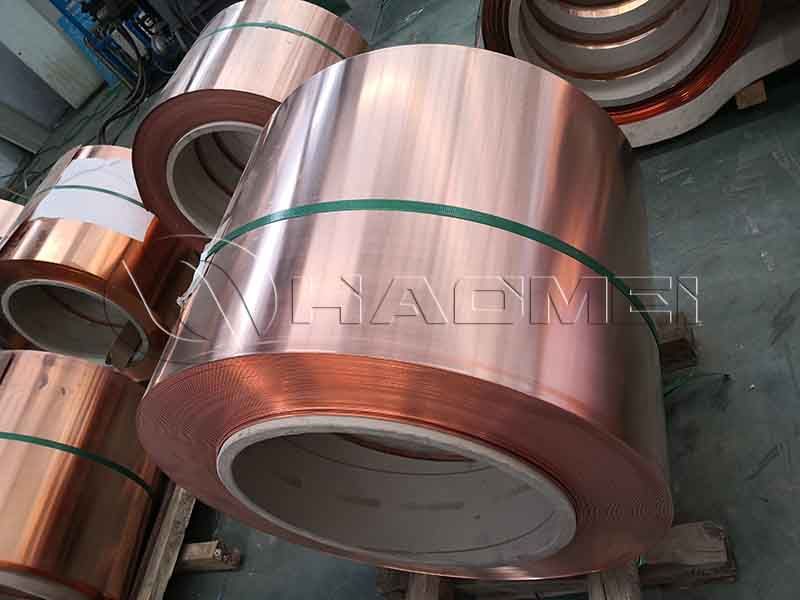
Mainstream Grades
1. T2 Copper Strip (National Standard)
T2 copper strip is the main material used in domestic power equipment. It conforms to the GB/T 2059 national standard, with a copper content ≥99.9%, extremely low impurity and phosphorus content, and a conductivity exceeding 100% IACS, fully meeting the requirements of high-voltage, high-current power transmission. This copper strip has excellent toughness, does not crack when bent, and has good weldability, making it suitable for complex processing scenarios such as winding, shielding, and connection of transformers and high-voltage cables. According to mechanical state, it can be divided into M soft state, Y2 semi-hard state, and Y hard state, among which the M soft state is specifically for power scenarios and is suitable for core processes such as winding and flexible shielding.
2. C11000 (American Standard ETP-Cu)
C11000 American standard copper strip corresponds to the Chinese national standard T2 copper material. It is an internationally used electrical tough copper grade, with purity and conductivity basically the same as domestic T2 copper strip. The product has stable performance, high surface finish, and precise dimensional tolerances. It is mainly used in export-oriented power equipment, foreign-made standard cables, and transformer products, and is a standardized conductive material commonly used in domestic and international power engineering projects.
Standardized Size Specifications
1. Transformer Copper Strip Dimensions
Transformer copper strip features thinness, wide width, and high precision. Mainstream specifications include a thickness of 0.1-2.5mm and a width of 14-650mm, all using M-soft material.
Side burrs are controlled within 0.01mm, preventing insulation damage, short circuits, and other faults. Thickness tolerance is ±0.01mm, ensuring smooth winding and uniform current distribution. Thin strips of 0.1-0.5mm are suitable for small dry-type and precision control transformers, while thick strips of 1.0-2.5mm are mostly used in high-voltage oil-immersed main transformers and high-power power transformers. 2mm copper strip is a common choice.
2. Cable opper Strip Dimensions
Cable copper strips conform to the NB/T10306-2019 standard and are divided into two categories: shielding layer and conductor connection. The mainstream thickness of shielding copper strips is 0.08-1.5mm, and the width can be customized according to the cable diameter, supporting precision slitting from 10-1000mm. Medium and high voltage power cables commonly use 0.3-1.0mm thick copper strips, balancing shielding sealing and flexibility, tightly wrapping the core to effectively block electromagnetic interference and ensure stable power transmission.
Core Applications
1. Transformer Field
Copper strip is the core raw material for transformer winding. Replacing traditional round copper wire can significantly improve winding fill rate and conductivity. T2 soft copper strip has excellent bending performance, can tightly fit the iron core, effectively reducing equipment size and lowering transformer no-load and load losses.
Widely compatible with dry-type, oil-immersed, and box-type transformers, the copper winding can evenly carry large currents, providing excellent heat dissipation and preventing overheating during long-term operation.
Simultaneously, the high-purity copper strip has low resistance, reducing power transmission losses and meeting the energy-saving requirements of the power grid. It can also be used in conductive connections such as transformer leads and terminal blocks to ensure stable equipment operation.
2. Power Cable Field
In high-voltage, ultra-high-voltage, control, and composite power cables, copper strip primarily serves three functions: electromagnetic shielding, grounding protection, and auxiliary conductivity. The electromagnetic fields generated by medium- and high-voltage cables can easily interfere with surrounding equipment and cause safety hazards.
The T2 copper strip closed-loop shielding structure effectively blocks internal and external electromagnetic interference, improving cable operation safety. Simultaneously, the copper strip can serve as an emergency grounding channel, quickly conducting fault current in case of insulation failure, triggering protection devices, and avoiding the risks of leakage and fire.
Furthermore, large-section cables can have their conductor structure optimized through copper strip splicing and wrapping, increasing current-carrying capacity and adapting to long-distance, high-load power transmission scenarios.
Special Processing Requirements for Electrical Copper Strip
Compared to ordinary industrial copper strips, power-specific copper strips must be suitable for harsh power conditions: the surface must be free of oxidation, scratches, and pinholes to avoid partial discharge and breakdown faults under high voltage; precise dimensional tolerances and burr-free slitting edges to prevent scratching insulation materials; uniform material and consistent conductivity to ensure balanced and stable power transmission; and excellent temperature and aging resistance to ensure long-term suitability for complex operating environments such as outdoor, underground, and enclosed cabinets.
Original source: https://www.alcustrip.com/a/electrical-copper-strip-grades-sizes-and-applications.html
Qoute Now
Contact Us
- Copper Strip for Electrical Transformer
- 1060 Alloy Aluminum Strip for Transformer
- Wholesale 1050 Aluminum Strip Transformer Winding
- Aluminum Strip for Cable Armor
- Finished Product Rewinding Cable Aluminum Strip
- Aluminum Strip for Argon Arc Welding
- Color Coated Aluminium Strip Roll for Cable Armor
- Copper Metal Strip for Cable Armor
- 1350 Aluminum Strip for Transformer
- 1070 Aluminum Alloy Strip
- Interlocking Armoured Cable Aluminum Alloy Strip
- Aluminum Strip Coil for Cable Shielding